Pinterest is very popular! If you have not visited yet, you are in for a real eye candy treat.
I have just started creating boards there, and I hope you will enjoy my initial offerings at Cherishops on Pinterest.
Follow me there to see when I create new boards, and follow my individual boards for new additions.
Here are the boards I have done so far:
Vintage Vanity
ForThe Birds
Mellow Yellow
The Blues by
Like a Rainbow
Pretty in Pink
The Glass is Greener
Vintage Wedding
Remtique Eclectic Vintage
Please also be sure to view the exciting boards created by those who follow my boards.
Happy Pinning !
See all Cheri's Shops by visiting The Vintage Village....Where Vintage Never Gets Old!
Thursday, March 29, 2012
Monday, August 9, 2010
Vintage Vanity Collectibles: Art Deco and Depression Era Glass Powder Jars and Puff Boxes
Vintage Vanity Collectibles: ArtDeco and Depression Era Glass Powder Jars and Puff Boxes
The years of The Great Depression in America brought much austerity and hardship, but also gave rise to promotional giveaways and inexpensive items, made from machine produced glass, that were specifically designed to be both eye catching and reusable in a number of ways, and so enticing cash starved buyers to splurge a little. As a result we have the collector’s treasure trove of popular Depression Glassware from the 1920s & 1930s. In addition to the colorful glass (designed to hide the flaws of the low cost production line), the striking designs of the Art Deco era made many of these pieces even more alluring. This is exemplified by the vanity items made during that time, which were usually sold filled with either face or body powder, fragrant bath salts, soaps, cold cream and other lotions, and of course, perfumes & colognes. Once the original products were used, the containers could be refilled with the same products, or used for decorative or other functional purposes. Some of the pieces were also originally sold as souvenirs.
The L.E. Smith Glass Company was by far the most prolific manufacturer of the Depression Glass figural vanity boxes and jars, often using the same base for different tops, as well as making different sizes and colors of the more popular items.
(c)Copyright Cheri's Shops August 9 2010
My lifelong love of gorgeous glassware reached its zenith when I discovered a 1990 reference book entitled "Bedroom and Bathroom Glassware of The Depression Years" by Margaret & Ken Whitmyer, and first saw the array of exquisite glass vanity collectibles that are now by far my favorite glass items from times past.
The figural powder jars and puff boxes from that era have come to have prize place in my collection, and usually sell very quickly in my shops, as the interest in them has soared (along with their prices!) over the past few years, and they are becoming very hard to find, especially in undamaged condition. Most of the jars have sculpted figural finials, designed more for artistic appeal than practicality, and this makes lifting and lowering the lid precarious, hence the chipped rims so often found. Occasionally these jars can still be found with their original product label attached, most often Ramses, Dermay or Guimet bath powder and salts.
Other American companies known to have made figural powder jars and puff boxes include Tiffin-US Glass, Phoenix, Consolidated, Co-Operative Flint, Akro Agate, New Martinsville, Paden City, Jeannette, and Westmoreland, amongst others, and a number of British and European manufacturers also made them, notably Sowerby in England, August Walther in Germany, and Taussant, Portieux & Vallerystahl in France, plus of course Heinrich Hoffman and other Czech Bohemian glassmakers.
The themes of the figurals on these vanity jars and boxes were as varied as the shapes and sizes, with ladies, especially Art Deco Flappers, being predominant. These female forms were beautifully designed, and have been given names by which the jars are now known, like Annette, Jackie, Godiva, Pandora, Claudette etc.
A few abstract human figurals were made, including Sphinx, jesters, minstrels, clowns and cherubs.
Dogs and birds were also popular, and there are also jars with figural cats, elephants, squirrels and even donkeys, camels and frogs.
Some of the most intricately designed jars and boxes have the form of coaches, wagons, cars and boats and a few were designed to resemble flowers, hats, buildings etc.
(c)Copyright Cheri's Shops August 9 2010
Wednesday, June 23, 2010
What Are Hair Receivers?
Bedroom and Bathroom Glassware and other Vanity Accessories are amongst the special vanity collectibles found at Cheri's Shops. Quite the most frequently asked question we receive on these items is "What are Hair Receivers?"
Well, as the name suggests, they received hair!
Dating from Victorian times through the early 1950s, hair receivers were a fixture on the dressing tables of most fashionable ladies. They were designed to hold hair that was removed from hairbrushes after vigorous brushing, and they resemble vanity jars or powder jars, but with the distinctive feature of having a finger sized opening hole in the center of the lid.
The comb would be run through the bristles of the hairbrush and the resultant hair accumulation would be coiled around a finger and then inserted into the opening of the hair receiver.
The uses of the hair was varied, but most frequently it was used in the creation of RATTS (aka rats) These were sheer hair nets that were stuffed full of the collected hair and then sewn shut. The ladies' hairstyles of that time were fashionable buns and other "big hair" arrangements. So ratts provided a "stuffing" to enhance these hairstyles!
In addition to this use for the hair kept in hair receivers, ladies also used the collected hair for a variety of other things, including as stuffing in pin cushions, for which the oiled and scented hair of that time was well suited, as it lubricated the pins, making them easier to use.
Small other cushions and pillows were also frequently stuffed with hair instead of feathers.
Hair receivers are made from a variety of materials including glass, metal, wood and ceramics, with the most notable ones usually being made from porcelain. They were produced in a range of styles, some flat, some footed, some square and most round in shape. Production appears to have been mainly European (The one at the top of this page is by Royal Bayreuth), and we have also found many Japanese hair receivers, including beautiful Nippon ones, like these:
My personal favourites are the exquisite jasperware hair receivers made by Schafer & Vater in Germany, like the ones pictured here.
Here are some other Bavarian Hair Receivers:
(c)Copyright Cheri's Shops 2010
Wednesday, June 16, 2010
Glass Glorious Glass Part 1: Depression, Elegant and Art Deco Glass
Hello,
my name is Cheri and I am a Glassaholic!
:)
I loooove gorgeous glassware, especially early 20th Century Glass ( and am also rather partial to the marvelous Mid Century Modern Glass...but that is a discussion for another day)
Here is a short synopsis on Depression, Elegant and Art Deco Glass that I wrote some years back for my original Alma's Attic Blog
Depression Glass:
The term Depression Glass refers to manufactured glassware that was
produced from the 1920's, through around the early 1940s, ie. the era of
the Great Depression until the end of WW2.
What we have come to know as Depression Glass was cheaply mass-produced,
mold pressed, colourful and highly patterned glass that was sold at
very low prices. These items would appear in soap or cereal boxes, or
might be given away at a local movie theater or gas station to promote
sales. In fact, one glass manufacturer, Hazel Atlas, was saved from
bankruptcy during the Depression years when it received an order from
Quaker Oats for five Railroad Cars of glass.
The reason for the varied colors and patterns was to hide the many flaws
in the cheaply produced glass. Sometimes the mold into which the glass
was poured didn't fill out completely, or air bubbles remained in the
glass. There are also sometimes lines in Depression Glass which are
known as "straw marks". It is not known how the theory that the hot
glass was placed on beds of straw to cool first arose, but it would have
caused the straw to burn! and so is an unlikely scenario. Instead, it
is more likely that these marks were the result of the instruments used
to remove the mold from the glass. These very flaws in the manufacturing
process are interestingly now what distinguishes genuine Depression
Glass from modern reproductions, and so gives it a higher value!
Elegant Glass:
The lovely Elegant Glass or Elegant Glass of the Depression Era
maintained a higher quality of glass, as well as a more refined
manufacturing process and pattern style, with beautiful etchings and
workmanship. It was more expensive than it's cheap and colorful cousin,
and certainly not given as freebies, and was thus favoured by wealthier
customers.
Elegant Glass was mainly handmade... either pressed, blown or a
combination of both (mold blown). The mold blown glass was first
heated in a glory-hole opening in a hot furnace and then put in a mold,
either by pressing or blowing. After removing it from the mold, the
piece was often crimped, flared, or cupped to add artistic flair.
Handles, feet or special ornamentation were also frequently applied.
After working it to a desired shape, it was put back into the glory-hole
to establish it’s final color. One of the last steps in the
glass-making process was to fire polish the piece, where the glass was
re-heated to remove any mold seams and to give it extra clarity. Some
companies further ground and polished the bottom to allow it to have a
smooth surface. Etched pieces had many labor intensive steps following
the glass-making process. The patterns that were etched were usually
found on several types of blanks, giving the customer a wide range of
choices in building their set. Elegant Glass was sold in fine department
and jewelry stores that also carried good China and Silverware
patterns, allowing customers to mix and match their selections according
to preference. Although some Elegant Glass was made in colors, usually
pastel, it was predominantly clear glass (aka crystal, which refers to
it's color rather than it's purity), which was preferred by the
wealthier customers who purchased this finer quality glassware.
Immediately preceding the years of the Great Depression, there were well
over 100 companies manufacturing glass in the United States, with most
of them located in the mid-western United States. By the time the
Depression ended, less than fifty remained. Bankruptcy, mergers and fire
were the major reasons that companies ceased operations. Some of the
larger and better known Depression Glass companies were Federal, Paden
City, MacBeth-Evans, U.S. Glass, Hazel-Atlas, McKee, Lancaster, Hocking
(later Anchor Hocking), and Jeannette. The smaller companies of that era
included Bryce, Bartlett-Collins, Standard, Dunbar, and Monongah .
British companies like Bagley and Sowerby also produced patterned
glassware during this period. All of these companies produced a vast
array of glass in many different colors, patterns and styles, with
entire tableware and household ranges that included all sorts of plates,
cups, bowls, pitchers, tumblers, goblets, butter dishes, cookie jars,
perfume bottles, candlesticks, cruets, coasters and so much more.
Art Deco Glass:
The name Art Deco came from the 1925 Exposition Internationale des Arts
Decoratifs Industriels et Modernes, held in Paris, and from which this
new, elegant style in architecture and applied arts, ranging from
luxurious objects made from exotic materials to mass produced
streamlined items, became available to a growing middle class. Art Deco
is broadly defined as the art movement involving a mix of modern
decorative art styles of the 1920s and 1930s, and derived from various
avant-garde painting styles of the early twentieth century. Art Deco
exhibits aspects of Cubism, Russian Constructivism and Italian Futurism,
with abstraction and simplification, particularly with geometric shapes
and highly intense colors celebrating the rise of commerce, technology,
and speed. The growing impact of the machine can be seen in repeating
and overlapping images from 1925 - 1930s, with streamlined forms derived
from the principles of aerodynamics.
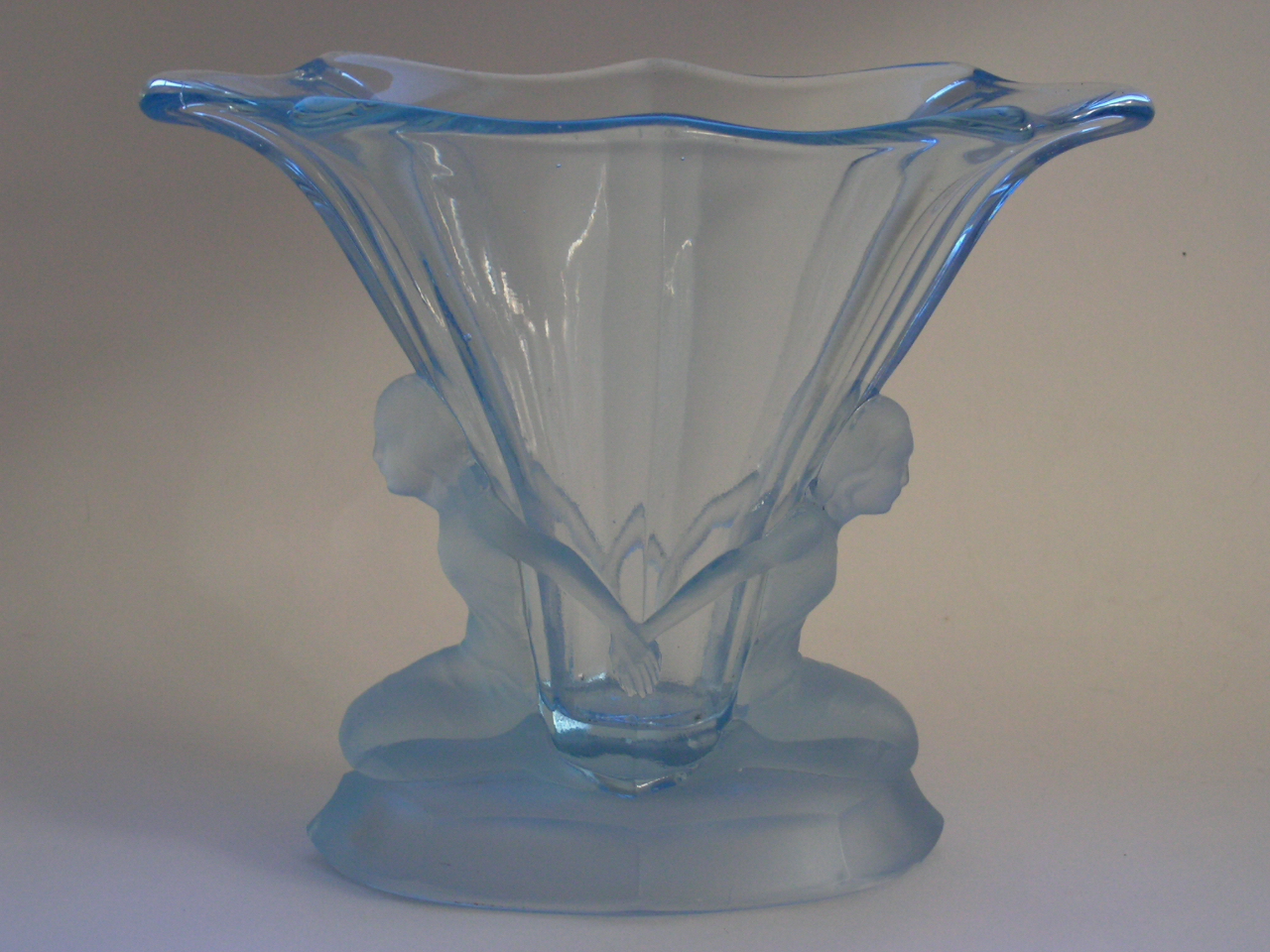
Art Deco glass comes in many forms, with the most popular seeming to be
the vases, figural flower frogs and figural boxes from that period
Art Deco Walther Glass vase
Art Deco Glass Pandora Ramses powder jar
Cheri's Shops in the Vintage Village ....where Vintage Never Gets Old!
(c) Copyright Cheri's Shops 2010
my name is Cheri and I am a Glassaholic!
:)
I loooove gorgeous glassware, especially early 20th Century Glass ( and am also rather partial to the marvelous Mid Century Modern Glass...but that is a discussion for another day)
Here is a short synopsis on Depression, Elegant and Art Deco Glass that I wrote some years back for my original Alma's Attic Blog
Depression Glass:
The term Depression Glass refers to manufactured glassware that was
produced from the 1920's, through around the early 1940s, ie. the era of
the Great Depression until the end of WW2.
What we have come to know as Depression Glass was cheaply mass-produced,
mold pressed, colourful and highly patterned glass that was sold at
very low prices. These items would appear in soap or cereal boxes, or
might be given away at a local movie theater or gas station to promote
sales. In fact, one glass manufacturer, Hazel Atlas, was saved from
bankruptcy during the Depression years when it received an order from
Quaker Oats for five Railroad Cars of glass.
The reason for the varied colors and patterns was to hide the many flaws
in the cheaply produced glass. Sometimes the mold into which the glass
was poured didn't fill out completely, or air bubbles remained in the
glass. There are also sometimes lines in Depression Glass which are
known as "straw marks". It is not known how the theory that the hot
glass was placed on beds of straw to cool first arose, but it would have
caused the straw to burn! and so is an unlikely scenario. Instead, it
is more likely that these marks were the result of the instruments used
to remove the mold from the glass. These very flaws in the manufacturing
process are interestingly now what distinguishes genuine Depression
Glass from modern reproductions, and so gives it a higher value!
Anchor Hocking Depression Glass Miss America pattern
Elegant Glass:
The lovely Elegant Glass or Elegant Glass of the Depression Era
maintained a higher quality of glass, as well as a more refined
manufacturing process and pattern style, with beautiful etchings and
workmanship. It was more expensive than it's cheap and colorful cousin,
and certainly not given as freebies, and was thus favoured by wealthier
customers.
Elegant Glass was mainly handmade... either pressed, blown or a
combination of both (mold blown). The mold blown glass was first
heated in a glory-hole opening in a hot furnace and then put in a mold,
either by pressing or blowing. After removing it from the mold, the
piece was often crimped, flared, or cupped to add artistic flair.
Handles, feet or special ornamentation were also frequently applied.
After working it to a desired shape, it was put back into the glory-hole
to establish it’s final color. One of the last steps in the
glass-making process was to fire polish the piece, where the glass was
re-heated to remove any mold seams and to give it extra clarity. Some
companies further ground and polished the bottom to allow it to have a
smooth surface. Etched pieces had many labor intensive steps following
the glass-making process. The patterns that were etched were usually
found on several types of blanks, giving the customer a wide range of
choices in building their set. Elegant Glass was sold in fine department
and jewelry stores that also carried good China and Silverware
patterns, allowing customers to mix and match their selections according
to preference. Although some Elegant Glass was made in colors, usually
pastel, it was predominantly clear glass (aka crystal, which refers to
it's color rather than it's purity), which was preferred by the
wealthier customers who purchased this finer quality glassware.
New Martinsville Elegant Glass Radiance pattern
Immediately preceding the years of the Great Depression, there were well
over 100 companies manufacturing glass in the United States, with most
of them located in the mid-western United States. By the time the
Depression ended, less than fifty remained. Bankruptcy, mergers and fire
were the major reasons that companies ceased operations. Some of the
larger and better known Depression Glass companies were Federal, Paden
City, MacBeth-Evans, U.S. Glass, Hazel-Atlas, McKee, Lancaster, Hocking
(later Anchor Hocking), and Jeannette. The smaller companies of that era
included Bryce, Bartlett-Collins, Standard, Dunbar, and Monongah .
British companies like Bagley and Sowerby also produced patterned
glassware during this period. All of these companies produced a vast
array of glass in many different colors, patterns and styles, with
entire tableware and household ranges that included all sorts of plates,
cups, bowls, pitchers, tumblers, goblets, butter dishes, cookie jars,
perfume bottles, candlesticks, cruets, coasters and so much more.
Sowerby Glass Pitcher
Art Deco Glass:
The name Art Deco came from the 1925 Exposition Internationale des Arts
Decoratifs Industriels et Modernes, held in Paris, and from which this
new, elegant style in architecture and applied arts, ranging from
luxurious objects made from exotic materials to mass produced
streamlined items, became available to a growing middle class. Art Deco
is broadly defined as the art movement involving a mix of modern
decorative art styles of the 1920s and 1930s, and derived from various
avant-garde painting styles of the early twentieth century. Art Deco
exhibits aspects of Cubism, Russian Constructivism and Italian Futurism,
with abstraction and simplification, particularly with geometric shapes
and highly intense colors celebrating the rise of commerce, technology,
and speed. The growing impact of the machine can be seen in repeating
and overlapping images from 1925 - 1930s, with streamlined forms derived
from the principles of aerodynamics.
Art Deco glass comes in many forms, with the most popular seeming to be
the vases, figural flower frogs and figural boxes from that period
Art Deco Walther Glass vase
Cheri's Shops in the Vintage Village ....where Vintage Never Gets Old!
(c) Copyright Cheri's Shops 2010
Sunday, June 13, 2010
Cheri's Shops
GO GREEN! Buy Antique and Vintage....the ultimate recycled goods
Hi and welcome to my new blog about my love of all things Vintage :)
By way of introduction, I will use this first post to introduce myself, and showcase my shops. I have been a collector all my life, and am delighted to have been able to share my love of antique and vintage collectible treasures by finding new homes for these special pieces from the past via an assortment of online venues since 2002.
The links and previews to my shops are also available at the top and bottom of this blog.
Cherishops Venues:
Remtique on Etsy
Eclectic Vintage!
Alma's Attic on eCrater
Where antique and vintage collectible treasures are found!
(c)Copyright Cheri's Shops 2010
Visit Cheri's Shops in The Vintage Village
Subscribe to:
Posts (Atom)